






















Residents of Kampala and other towns have long voiced frustration over the growing eyesore of tangled fibre optic cables and multiplying utility poles cluttering streets, pavements, and neighbourhoods.
As more internet service providers enter the market to meet surging demand for faster connectivity, the problem has worsened, turning what should be a digital boom into an urban nightmare of visual pollution, safety risks, and disorganized infrastructure.
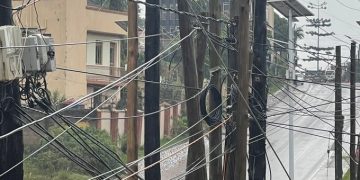
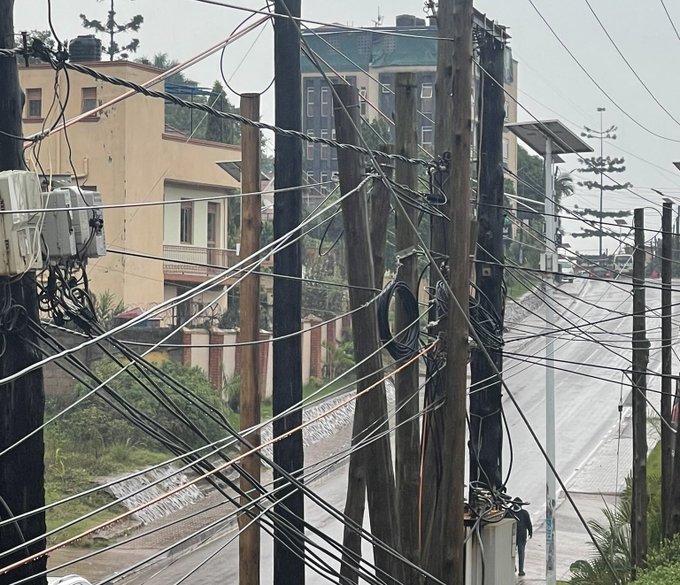
Over time, locals have described Kampala’s streets as increasingly chaotic. Once notorious mainly for potholes, the capital is now often called a “city of fibre poles and cocktail of cables.”
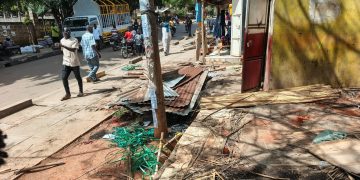
Residents complain of “spaghetti-like” wires dangling overhead, multiple crooked or leaning poles crammed together, sometimes five, six, or more in a single spot, and cables crisscrossing like tangled vines.
In suburbs and areas like Kololo, Bugolobi, Kyebando, Nsooba, Mulago, and beyond, these installations block walkways, damage trees, obscure road signs, and create hazards for pedestrians and drivers.
One resident, writing in local media earlier this year, lamented how the once-beautiful roadside scenery in suburban communities has turned into “a real mess,” with mismatched poles of varying heights disrupting aesthetic coherence.
“UMEME (referring to Power utility) had slowly cleaned up their mess,” the writer noted, “then the fibre internet providers came in and messed up everything.”
Similar sentiments echo in opinions shared across platforms, where people highlight how new providers plant poles independently, ignoring existing infrastructure and urban planning.
Experts and observers have dubbed it “Uganda’s fibre wars”, a wasteful scramble among competing ISPs. Instead of sharing poles, ducts, or trenches to expand coverage efficiently, especially to underserved rural areas, companies duplicate efforts in already-connected urban zones. This leads to unnecessary costs, environmental harm, and safety issues, including confusion between electric and fibre lines, falling weak poles due to poor workmanship, and risks from cluttered pavements.
The influx of more players into Uganda’s internet market has intensified the complaints. With broadband expansion accelerating, each new entrant rushes to lay its own cables and erect poles, often without coordination. Residents argue this “fibre madness” prioritizes competition over common sense, leaving cities uglier and more disorganized despite promises of better connectivity.
In response to mounting public outcry, including from government bodies and everyday citizens, the Uganda Communications Commission (UCC) has stepped in decisively.
On Monday, March 23, 2026, the regulator issued a public notice acknowledging these widespread concerns about uncoordinated and untidy fibre deployments, particularly in the Greater Kampala Metropolitan Area and other parts of the country.
The UCC directed all stakeholders to streamline installations and reduce clutter. It pointed to the Framework for Optical Fibre Installation, Maintenance, Protection and Disposal, effective since January 1, 2026, which mandates prior approval for deployment plans and strongly promotes infrastructure sharing.
Operators, according to UCC, must now prioritize using existing poles and facilities, relocate cables to shared setups where duplication exists, and decommission redundant ones. The framework also sets standards for safe, coordinated rollouts along roads.
The commission stressed collaboration with local governments to integrate telecom infrastructure into civil works and road projects, while encouraging underground cabling to preserve urban aesthetics and enhance safety. It warned that careless civil works damaging existing networks disrupt services for everyone.