


























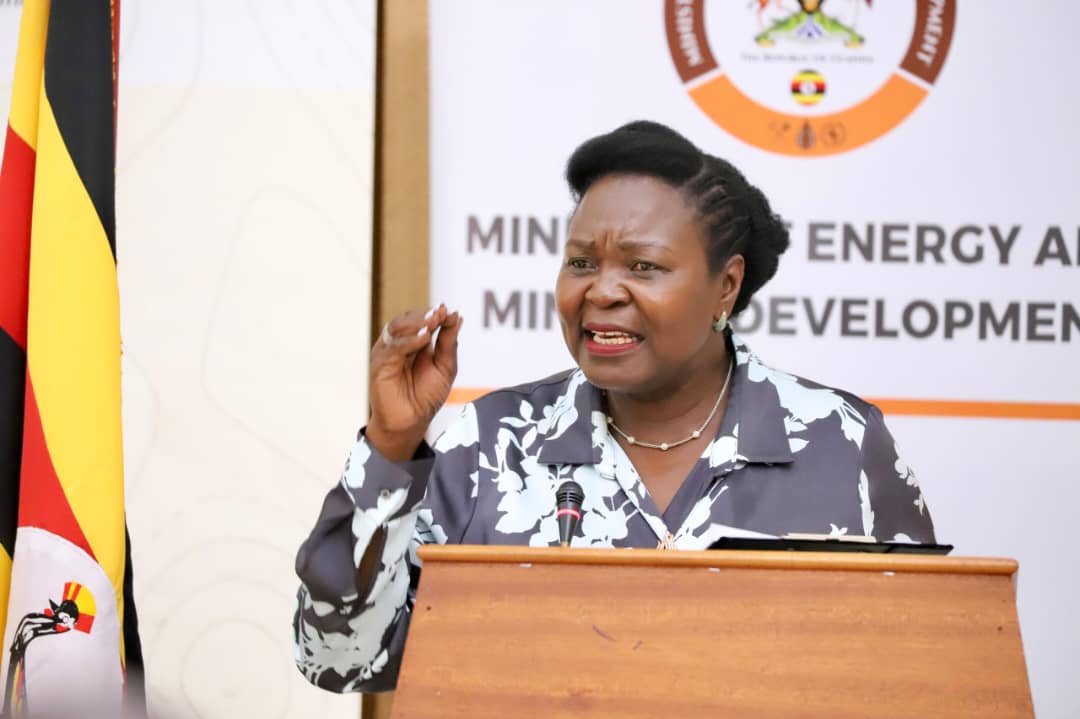
Ruth Nankabirwa Ssentamu, Minister of Energy and Mineral Development, has cautioned oil marketing companies against raising pump prices, insisting there is “no basis or reason” for any increases because fuel supply to the country has not changed, at least for now.
In a video statement posted on X (formerly Twitter), the minister said that the government is “closely watching and monitoring companies that want to take advantage of this situation and exploit Ugandans.”
Minister Nankabirwa provided specific details on current stocks and incoming shipments to reassure the public. She stated that Uganda currently has enough petrol to last 26 days, diesel for 21 days, and aviation fuel for 40 days.
“Uganda remains stable in fuel supply. As of now, we have stocks for 21 days of diesel, 26 days of petrol, and 40 days of Jet A-1. We also have shipments scheduled for April, coming from different parts of the world and avoiding the problematic Strait of Hormuz.”
She added that more shipments are on the way. The country expects 283 million litres of petrol and 183 million litres of diesel. These will add about 51 days of supply once delivered.
“Do not increase pump prices. UNOC will guide any necessary adjustments where costs have risen, but for now, no price increases should be made in March.”
The remarks come amid heightened global oil market uncertainty triggered by escalating conflict in the Middle East, including tensions involving Israel, Iran, and the United States.
Earlier this month, the minister and the Uganda National Oil Company (UNOC) had already assured the public that Uganda holds sufficient fuel stocks and that scheduled shipments for March and April had already cleared key routes, with no rise in wholesale costs from UNOC.
Despite these repeated assurances, pump prices at several stations across the country have continued to edge upward. Motorists and journalists report increases of between UGX 150 and UGX 300 per litre in recent weeks.
In Kampala and surrounding areas, petrol is now selling for UGX 5,250–5,300 at major outlets, while some stations in western Uganda have been reported as high as UGX 5,600. Diesel prices have similarly risen to around UGX 4,700–5,000 in many locations.
For more than a year, pump prices had remained relatively stable, with petrol averaging about UGX 5,080 and diesel UGX 4,950. Gradual increases began in January, but the latest hikes have drawn sharp public criticism.
The Ministry of Energy maintains that the fuel currently on the market was procured before recent global price spikes and that UNOC has not adjusted its supply costs to dealers. Officials have described some of the pump increases as “unwarranted” or “premature,” noting that the current stocks were imported at pre-crisis rates.
The government has previously blamed part of the pressure on the weakening Ugandan shilling against the US dollar rather than solely on international crude oil movements.
Social media users and consumers have accused oil marketing companies of exploiting the Middle East situation, with some complaining that stations operated by TotalEnergies and Vivo Energy (Shell) were among the first to raise prices.
Since 2024, UNOC has held exclusive rights to import and supply all petroleum products into Uganda, following the passage of the Petroleum Supply (Amendment) Act.
Parliament granted this monopoly specifically to eliminate middlemen in the supply chain, particularly reliance on Kenyan intermediaries, which had long been blamed for causing price fluctuations, supply instability, and higher costs to consumers.
Under the arrangement, UNOC sources fuel through its five-year contract with Vitol Bahrain and sells in bulk to licensed oil marketing companies at controlled wholesale prices.
The government’s stated aim was to bring stability, reduce profiteering, improve supply security, and ultimately keep pump prices more predictable and affordable for Ugandans. UNOC does not retail fuel directly; oil marketing companies handle distribution and retail sales.