















Have we, as a global community, reached that haunting threshold where outrage has become ritual and condemnation a hollow performance repeated while the world burns? There is something deeply unsettling about a civilization that has perfected the language of justice, yet hesitates when called upon to defend it. In Lebanon today, the sky does not merely carry the sound of war; it carries the echo of a broken promise, a promise that the innocent would be protected, that law would restrain power, and that humanity would never again stand idle in the face of preventable suffering.
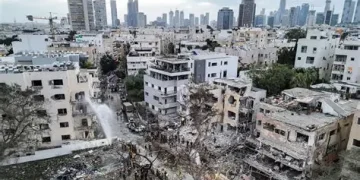
In the span of mere minutes, more than one hundred airstrikes descended upon Lebanese communities, killing over three hundred people and injuring more than one thousand one hundred others. These are not distant figures to be absorbed and forgotten; they are lives abruptly extinguished, families erased in an instant, and futures buried beneath collapsing concrete. In a single day, at least two hundred fifty four people were killed and over one thousand one hundred sixty five injured. Since the escalation began in March two thousand twenty six, the death toll has surpassed one thousand seven hundred, with nearly six thousand wounded and more than one point two million people displaced. These numbers do not simply describe a conflict; they define a humanitarian catastrophe unfolding in real time.
These figures echo patterns documented in past escalations. Reports by Amnesty International and Human Rights Watch have repeatedly raised concerns over the disproportionate use of force, indiscriminate attacks, and the failure to adequately distinguish between civilian and military targets in conflict zones involving Israeli military operations. Similarly, the United Nations Office for the Coordination of Humanitarian Affairs has consistently warned about the devastating humanitarian consequences of such escalations on civilian populations.
Let us not obscure what is increasingly evident and widely alleged across global discourse. This wave of suffering, destruction, and relentless bombardment has been attributed to military actions by Israel. It is therefore both troubling and morally disorienting that, even in the face of such devastation, Israel continues to occupy space on international platforms, including the United Nations, where it seeks to justify its conduct under the language of security and counterterrorism. That reality is not merely controversial; it is profoundly shameful and deplorable. For when the accused stands before the court of global opinion and speaks without consequence, the line between accountability and impunity dissolves.
Amid this devastation stood those who embodied the fragile hope of international order, the United Nations peacekeepers. They came not as participants in war, but as guardians of peace, entrusted by the world to hold the line between violence and humanity. Among them were Indonesian soldiers who left their homeland in service of peace, only to be returned lifeless. Their deaths, caused by projectiles and explosions, have been acknowledged as potential war crimes. Under international humanitarian law, particularly as reinforced by the mandates of the United Nations Interim Force in Lebanon, attacks on peacekeepers may constitute war crimes. The International Criminal Court recognizes intentional attacks against peacekeeping personnel as prosecutable offenses under the Rome Statute.
In response, sixty three countries and the European Union raised their voices in condemnation. Their collective statement affirmed what should never have required affirmation: that attacks on peacekeepers are unacceptable, that such actions violate international law, and that accountability must follow. Yet even as these words were spoken, the bombs did not cease. The wounded continued to suffer, the displaced continued to flee, and the dead continued to be counted. One is compelled to ask, with growing urgency, what is the value of condemnation if it does not alter the course of events?
The principles enshrined in the Geneva Conventions and their additional protocols were not crafted as abstract ideals. They were forged in the aftermath of unimaginable horrors, as a solemn commitment that even in war there would be limits, that civilians would be protected, that hospitals would remain sanctuaries, and that journalists and peacekeepers would be shielded from harm. Yet today, these principles appear increasingly fragile. Hospitals have been struck, civilian infrastructure reduced to rubble, and entire communities shattered. The distinction between combatant and civilian has blurred, not by accident, but by the relentless erosion of restraint. The International Committee of the Red Cross has long emphasized the principles of distinction, proportionality, and precaution, principles that appear increasingly disregarded in modern theatres of conflict.
Beyond Lebanon, the region bears the marks of a widening crisis. In Iran, thousands have been killed, including over one thousand seven hundred civilians, with more than fifteen thousand injured. Infrastructure has been devastated and communities uprooted. Syria continues to endure cycles of violence that deny its people any semblance of stability, while Yemen remains trapped in a protracted humanitarian disaster that has claimed countless lives over the years. This is not a series of isolated conflicts; it is a pattern of instability that feeds upon itself, a regional tragedy that demands a global response.
What is perhaps most troubling is the normalization of this suffering. Statements of concern are issued, meetings are convened, and resolutions are drafted, yet the violence persists. Declarations that there will be no ceasefire are made openly, even as the human cost continues to rise. The world listens, reacts, and then returns to its routines. In this cycle, outrage loses its power and impunity finds its footing.
It is in this context that the continued diplomatic accommodation of Israel becomes increasingly indefensible. A state accused of actions that result in mass civilian casualties, widespread destruction, and the targeting of protected persons cannot be shielded indefinitely by rhetoric, alliances, or procedural delays. To allow such a state to stand before the international community and justify its actions without immediate and tangible consequences is to erode the moral authority of the very institutions designed to uphold justice. It sends a dangerous message that power, not principle, determines accountability.
Silence, or worse, passive condemnation without action, carries grave consequences. It risks becoming complicity. For what is unfolding is not merely aggression in the conventional sense. There is a growing and deeply troubling perception across the world that what is being presented as a war on terror is, in reality, a sustained campaign that bears the hallmarks of collective punishment and, to many observers, genocide in disguise. It is therefore unsurprising that legal debates and concerns have increasingly surfaced within global judicial discourse, including in proceedings and deliberations associated with the International Court of Justice.
If the international community continues to respond with words alone, it must be prepared to confront the repercussions of its inaction. Impunity does not remain contained; it spreads. It emboldens other actors, weakens legal norms, and undermines the fragile trust upon which global order depends. Today it is Lebanon. Tomorrow, it may be elsewhere. The precedent being set is one that will reverberate far beyond the immediate theatre of conflict.
Amid this global hesitation, there are voices that have risen with clarity and conviction. African nations, drawing upon their own histories of struggle and resilience, have joined others in condemning these acts. Their stance reflects a deep understanding that justice must not be selective and that the value of human life must be upheld without exception. Their solidarity is a reminder that moral courage is not the preserve of the powerful, but the responsibility of all.
The United Nations now stands at a defining moment. Its peacekeepers have been killed, its principles tested, and its authority questioned. To condemn is necessary, but it is not sufficient. The credibility of international law depends not on its articulation, but on its enforcement. Mechanisms for accountability already exist within the international system. The United Nations Human Rights Council has previously established independent commissions of inquiry into alleged violations in conflict zones, while the International Criminal Court retains jurisdiction over war crimes, crimes against humanity, and genocide where applicable.
Every moment of inaction carries consequences. It signals to victims that their suffering is not urgent and to perpetrators that the boundaries of accountability can be stretched further. It erodes the credibility of international institutions and undermines the very idea that law can govern the conduct of nations. In such a context, neutrality ceases to be a position of balance and becomes, instead, a quiet endorsement of the status quo.
The path forward requires more than words. It demands coordinated, decisive action grounded in the principles that the international community claims to uphold. Legal accountability must be pursued without fear or favor. Diplomatic efforts must be intensified to secure an immediate cessation of hostilities. Economic and political measures must be considered to ensure compliance with international law. Mechanisms within the United Nations must be strengthened, not circumvented, so that their authority is not reduced to symbolism. Above all, the protection of civilians must be treated not as a negotiable objective, but as an absolute obligation.
Efforts must be deliberately designed to curtail this apparent arrogance of impunity and to restore the credibility of international law. Sanctions, independent tribunals, and enforceable resolutions must no longer remain theoretical tools but must be activated with urgency and consistency. The United Nations must reclaim its mandate, not as a stage for justification, but as an instrument of justice. If it fails to do so, it risks becoming a witness to injustice rather than its challenger.
The people of Lebanon deserve more than expressions of sympathy. They deserve protection, justice, and the restoration of their dignity. The fallen peacekeepers deserve more than remembrance; they deserve a world that honors their sacrifice by ensuring that such violations do not recur. The credibility of the international system itself hangs in the balance.
History will judge this moment with clarity. It will ask whether the world chose to act or to remain passive, whether it upheld its principles or allowed them to erode. It will measure not the eloquence of our statements, but the effectiveness of our actions. And it will determine whether, in the face of profound suffering, humanity rose to meet its responsibility or retreated into silence.
The warning must therefore be stated without ambiguity. Any continued silence, or condemnation unaccompanied by decisive action against Israel, will not remain without consequence. It will boomerang upon the very architects of inaction, for a world that tolerates unchecked aggression and shields it under the pretext of security invites the erosion of its own stability. Justice cannot be selectively applied without ultimately collapsing under the weight of its contradictions.
The time has come for a renewed and unambiguous commitment to justice. The time has come for nations to stand not as isolated actors, but as a united community bound by shared values and mutual responsibility. Global solidarity must move beyond rhetoric and manifest in collective action that confronts impunity with resolve and consistency. For justice is not an abstract ideal to be admired from a distance; it is a living principle that must be defended, even when doing so is difficult. And if the world is to preserve its moral foundation, it must now stand together, firmly and without hesitation, to ensure that impunity is neither tolerated nor allowed to define the future of humanity.
By Twiine Mansio Charles
CEO and Founder of The ThirdEye Consults (U) Ltd