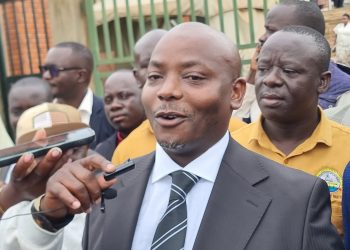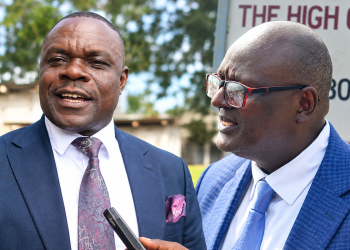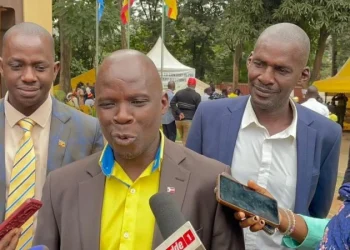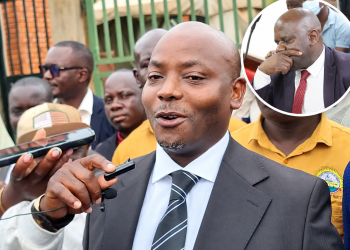





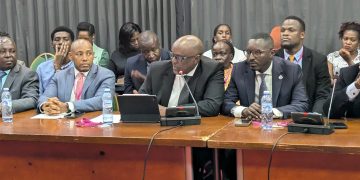
















The legal battle over the Mukono North parliamentary election has intensified after lawyers for former State Minister for Water Ronald Kibuule told the High Court that Abdallah Kiwanuka’s defence could collapse if the court finds that his affidavits do not comply with the rules governing election petitions.
The heated exchange unfolded on Tuesday before Justice Godfrey Himbaza, as Kiwanuka’s lawyers responded to a preliminary objection raised by Kibuule’s legal team on Monday, seeking to have the respondent’s answer and affidavits struck out.
Kibuule is challenging Kiwanuka’s victory in the Mukono North County parliamentary election and is seeking, among other remedies, a recount, citing alleged electoral irregularities and malpractice.
The dispute now centres on whether Kiwanuka properly supported his answer to the petition with an affidavit containing facts upon which he relies in defending the election result.
Kiwanuka’s lawyer, Chrysostom Katumba, urged Justice Himbaza not to strike out his client’s filings, arguing that the rules do not prescribe a particular format in which a respondent must frame an answer.
Katumba relied on Rule 26 of the Parliamentary Elections Act (Interim Provisions Rules) to argue that an election petition should not be defeated merely because of a formal objection or a defect in a notice or document.
He maintained that the central purpose of Kiwanuka’s answer and affidavit was to oppose Kibuule’s petition and that the respondent had complied with the requirement to file an affidavit.
Katumba also defended the second affidavit filed by Kiwanuka, saying it was intended to respond to affidavits filed late by witnesses for the petitioner.
He told court that Kiwanuka had earlier complained on April 17, 2026, about the late filing of the witnesses’ affidavits and argued that the additional affidavit should therefore be allowed to remain on the record.
Katumba asked court to allow Kiwanuka to proceed with the affidavits in his defence.
But Kibuule’s lead lawyer, Frank Kandiho, rejected the explanation, arguing that Kiwanuka’s response had failed to address the central legal complaint raised by the petitioner.
Kandiho asked Justice Himbaza to focus on the wording of Rule 8(3)(a), arguing that the provision contains three critical requirements: the affidavit must state facts, those facts must be facts upon which the respondent relies, and they must support the respondent’s answer to the petition.
He challenged Kiwanuka’s affidavit, arguing that instead of presenting facts supporting his own answer, it largely attacked various paragraphs of Kibuule’s petition and the petitioner’s evidence.
Kandiho put the central question to court as whether Kiwanuka’s affidavit, in its present form, is genuinely an affidavit stating the facts upon which the second respondent relies in support of his answer, or whether it is effectively an affidavit responding to Kibuule.
The argument places the validity of Kiwanuka’s defence directly before Justice Himbaza. Kandiho further questioned the legality of the second affidavit, which he said was filed five days after Kiwanuka’s first affidavit.
He questioned whether Kiwanuka was entitled to file a second affidavit and whether the additional document could lawfully be used to respond to affidavits filed by witnesses for the petitioner.
The petitioner’s lawyers also challenged the heading of the second affidavit, which the defence reportedly attributed to a typographical error.
Kandiho warned that if court upholds their objection and strikes out the impugned affidavits, the consequences would go beyond simply removing documents from the court record.
He argued that Kiwanuka would be left without a valid affidavit supporting his answer and, consequently, with no defence to the petition.
Kandiho also argued that there would be no legal basis for Kiwanuka to proceed with witnesses if the court finds that his supporting evidence is invalid.
Their position is that election petitions are governed by specific procedural rules and that parties cannot introduce documents outside those rules.
Ivan Bwowe, another lawyer for Kibuule, reinforced the argument, telling the court that election petition proceedings are “rules based” and that anything filed outside the prescribed procedure is not merely defective but illegal.
Bwowe cited several authorities in support of the objection.
Courtroom Clash Over Lawyers
The proceedings also briefly turned to the arrangement of lawyers inside the courtroom.
Kandiho questioned the presence of some members of Kiwanuka’s legal team at the bar, saying some had not been introduced and asking whether they were properly authorised to sit there.
Justice Himbaza subsequently directed Katumba’s assistants to vacate the bar and also directed Kiwanuka to move from the side occupied by Kibuule and his legal team.
The courtroom exchange added another tense moment to a case that has now entered a crucial procedural stage.
Ruling Set for Wednesday
After hearing arguments from both sides, Justice Himbaza reserved his ruling for Wednesday afternoon.
The ruling is expected to determine whether Kiwanuka’s challenged affidavits can remain on the court record and whether his defence will proceed in its current form.
The outcome could have a significant bearing on the next stage of the election petition, which is challenging Kiwanuka’s victory in Mukono North.
The court’s ruling is expected to be posted on the Electronic Court Management Information System (ECMIS).
ENDS.