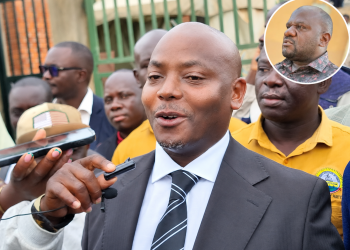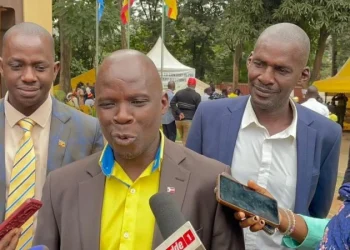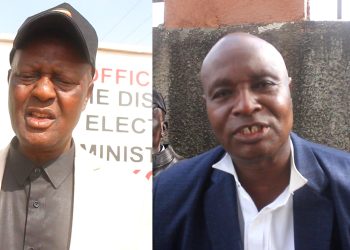



















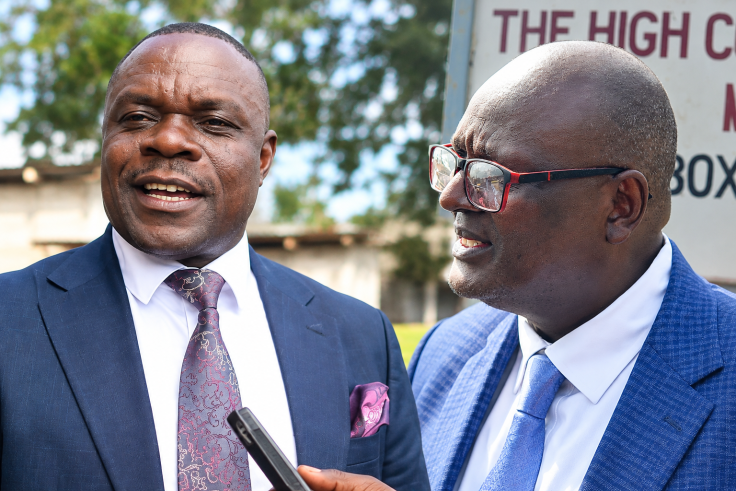
MUKONO —Justice Phillip Mwaka has rejected video evidence tendered by Arthur Kiiza in the Bbaale County parliamentary election petition, ruling that the material had not been properly authenticated and did not meet the legal requirements for electronic evidence.
Kiiza petitioned court challenging the election of Charles Tebandeke as Bbaale County Member of Parliament in Kayunga District, alleging that the campaign was marred by intimidation, blackmail, sectarian remarks and other irregularities.
The hearing taking place at Mukono High Court Circuit, which had initially been scheduled for mention and fixing, proceeded directly to the cross examination of Kiiza by lawyers representing Tebandeke.
Much of the cross examination centred on statements allegedly made by Tebandeke during campaign rallies, where he is said to have referred to Kiiza as “Goliath”, portrayed him as a stranger in the constituency and questioned his roots in the area.
However, Kiiza acknowledged that he was not personally present at several of the meetings where the statements were allegedly made.
He told court that Samuel Lule and John Kigundu informed him about an alleged incident at the burial of Mutazibwawo on October 29, 2025, where he claimed Tebandeke made blackmailing remarks.
Kiiza admitted that he could not identify a particular voter who changed their vote as a result of the alleged statements.
He similarly told court that he learnt about remarks made at a November 12 rally in Mugomba from Swaibu Kalema and another person identified as Nakamoga, who recorded the proceedings.
At the rally, Tebandeke allegedly described Kiiza as a stranger in the community and challenged him to identify his parents and demonstrate his roots in the area.
Kiiza also relied on an alleged statement made at Nakyesa on December 16, where Tebandeke is said to have accused the President of bringing “another Rwandan” to steal land.
At Shell Petrol Station on December 19, Tebandeke allegedly urged voters not to elect candidates associated with land grabbing and referred to his opponent as a “rotten jackfruit”.
Kiiza told court that he had been informed by lawyers from JB Byamukama Advocates that such statements amounted to sectarian appeals.
He also alleged that Tebandeke associated him with electoral violence involving his uncle, whom he described as a military general.
At Kisalizi Trading Centre on November 15, Kiiza said Tebandeke allegedly questioned his legitimacy in the area because he was renting a house instead of owning one.
During cross examination, however, defence lawyer Gilbert Bukiya pressed Kiiza over whether Tebandeke had ever directly mentioned his name.
Kiiza conceded that Tebandeke did not directly name him but maintained that the reference to “Goliath” was understood in Bbaale to mean him.
Bukiya produced Kiiza’s national identification document and asked him to show where the name “Goliath” appeared.
Kiiza acknowledged that the name was not indicated on his identification document.
The petitioner nevertheless maintained that he understood the references to be directed at him based on the context of the campaign and previous political exchanges.
“I was able to read Tebandeke’s mind,” Kiiza told court, maintaining that blackmail had characterised the campaign.
He denied allegations that he was a farm manager for General Tumukunde and rejected accusations of land grabbing.
Kiiza also testified that some of Tebandeke’s supporters disrupted his campaign activities, describing them as people wearing red berets and T-shirts.
He said some people chased him from rallies while accusing him of being a land grabber, and that one of his supporters was injured and hospitalised.
He told court that he reported the incident to police and had a reference to support his claim.
However, Kiiza conceded that Tebandeke himself had never personally attacked him or prevented him from campaigning.
TikTok evidence challenged
The most consequential part of the proceedings came when the defence lawyers headed by Banard Onyango challenged the admissibility of videos that the petitioner intended to rely on to prove the alleged statements.
Kiiza told court that he did not own the TikTok accounts from which some of the videos had been obtained and that he was not present when the videos were originally recorded.
He said he had engaged an IT forensic expert, Richard Emuye, to examine videos downloaded from TikTok accounts associated with Tebandeke and Shakira.
Onyango argued that the videos were essentially copies downloaded from social media and that neither the original devices nor the people who originally uploaded the videos had provided affidavits establishing their authenticity.
The defense argued that the petitioner had failed to establish the chain of custody of the electronic evidence.
He said the court could not establish what happened to the videos between the time they were allegedly downloaded and when they were handed to the expert for examination.
The defence further argued that TikTok videos are compressed and re-encoded when uploaded, meaning that the versions downloaded from the platform could not automatically be treated as the original recordings.
Bukiya relied on provisions of the Electronic Transactions Act, arguing that the burden of proving authenticity and identification of electronic evidence rests on the person seeking to have it admitted.
He also raised concerns about the possibility of manipulated or artificially generated video and audio, arguing that the circumstances under which the material was obtained did not satisfy the legal threshold for admission.
The defence asked Justice Mwaka to exclude the videos from the petitioner’s evidence.
Petitioner’s lawyer Rogers Katunguka opposed the objection, arguing that the videos represented the best evidence available to his client.
He noted that some of the recordings existed in their original form on a Samsung A061 phone used by witness, while others had been downloaded from TikTok.
Katunguka said the material had been examined by an expert, who concluded that the videos were in a form capable of being presented to court.
He further submitted that the recordings had been transcribed into English for purposes of court proceedings.
The defence maintained that the original recorders had not sworn affidavits and that there was no evidence establishing that the TikTok account holders had personally recorded the material or that the videos had not been altered before being uploaded.
Judge rules videos inadmissible
Justice Mwaka ruled in favour of the defense team, finding that the electronic evidence had not been sufficiently authenticated.
The judge noted that Kiiza had not personally recorded the videos and that the devices allegedly used to make the recordings had not been submitted to the forensic expert for verification.
The court also found that the petitioner could not independently verify the authenticity of the videos.
Justice Mwaka described the electronic evidence as “premature and untenable” and ruled that the material tendered on flash drives was inadmissible.
The ruling means the petitioner will not, at this stage, rely on the disputed videos to support his allegations concerning statements allegedly made during the campaign.
Witnesses face contradictions
The court thereafter proceeded to cross examine Stella Nakamoga, 26, a farmer and resident of Kisalizi in Galiraya Sub County, who had sworn an affidavit on August 14, 2026.
Nakamoga told court that she attended a rally at Kisalizi Trading Centre and recorded the proceedings from the beginning until about 7pm.
She initially said she had recorded a single video but, when referred to her affidavit, acknowledged that it stated that the recording had been made in three sequences.
Asked to estimate the duration of the recordings, Nakamoga said each was almost one hour long, although she could not recall the exact duration of each segment.
She also acknowledged that Tebandeke did not mention Kiiza by name anywhere in the recordings.
Instead, she said, he repeatedly referred to “Goliath”.
Nakamoga maintained that she understood the reference to mean Kiiza, although when asked how she knew what Tebandeke meant, she indicated that she understood the context.
Defence lawyers also questioned her evidence that Tebandeke was referring to Kiiza when he allegedly spoke about a person renting a house in Kayunga.
Nakamoga maintained that the statement referred to Kiiza.
Her evidence on the preservation of the recordings also came under scrutiny.
She told court that the videos remained intact and that nobody had extracted copies from them.
However, her affidavit indicated that her brother, Muwonge, had removed the recordings and handed them to the expert for examination.
Nakamoga also acknowledged that she had read the expert report but later told court that she could not read English and had relied on an interpreter to help her understand it.
Phone owner gives evidence
Lawuence Muwonge, 30, whose phone was allegedly used to record the rally, was subsequently called to testify.
Muwonge confirmed that he owned the phone and that his sister had used it to record the proceedings.
He said he received the phone back in March after it had been used in connection with the forensic examination.
Muwonge told court that he had watched the video and confirmed that Tebandeke did not mention Kiiza’s name, although he said the petitioner was allegedly referred to as “Goliath”.
His testimony also raised questions about how the phone and videos moved between the petitioner and the expert.
Muwonge said he took the phone to the petitioner on his instructions so that it could subsequently be handed over to the expert.
He told court that he met the expert at City Oil and watched only one video of approximately eight minutes.
He signed a document acknowledging that he had handed over the phone but said he left before the expert extracted any material from it.
During cross examination, Muwonge said he had forgotten the phone at home on one occasion, although he maintained that the expert returned it to him on March 30.
He admitted that he had not checked the phone since receiving it back and could not tell whether the videos were still stored on it.
The proceedings have now shifted attention to the handling of the physical device that allegedly contains the original recordings.
Justice Mwaka adjourned the matter to Saturday and directed Muwonge to return to court with the phone.
The court also ordered the IT expert, Richard Bwire, to appear for cross examination alongside other witnesses.
The continuation of the hearing is expected to focus further on the disputed electronic evidence, the handling of the phone and the petitioner’s allegations concerning Tebandeke’s campaign conduct.
The case remains before Justice Phillip Mwaka at the Mukono High Court Circuit.
ENDS.