



















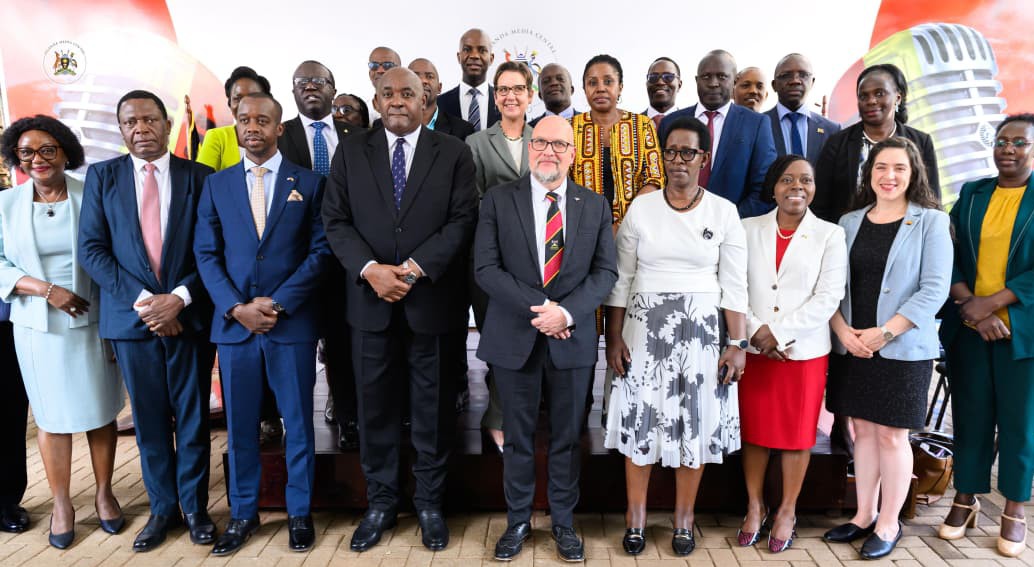
Uganda’s HIV prevalence among adults aged 15 years and above has remained at 5.9 per cent, with women continuing to carry a higher burden of the epidemic, according to preliminary findings from the 2025 Uganda Population-Based HIV Impact Assessment (UPHIA).
The findings released Thursday by the Ministry of Health show that HIV prevalence stands at 7.3 per cent among women, compared with 4.1 per cent among men, with an estimated 1.496 million adults living with HIV.
Health Minister Dr Chris Baryomunsi said the unchanged prevalence compared with the 2020 assessment signals a need to strengthen prevention, testing and treatment efforts.
“While we appreciate the decline over the years, still a percentage of 5.9 per cent is high,” Baryomunsi said, noting that the country needs to work harder to bring down new HIV infections.
The assessment found that 85.3 per cent of people living with HIV know their status, while 99.1 per cent of those who know their status are on antiretroviral treatment and 96.5 per cent of those on treatment are virally suppressed.
The results show that Uganda has surpassed the treatment and viral suppression components of the global 95-95-95 targets, but remains below the first target of having 95 per cent of people living with HIV know their status.
Baryomunsi said this leaves roughly 15 per cent of people living with HIV unaware of their status, creating a major gap in the national response.
“This is now the call to action. I call upon every Ugandan to know their HIV status,” he said, adding that testing services are available free of charge at health facilities across the country.
The assessment also found that 86 per cent of all adults living with HIV aged 15 years and above were virally suppressed, regardless of whether they knew their status or were receiving treatment. This represents an improvement from 75.4 per cent in 2020.
However, the findings point to concerns among young people. HIV prevalence among those aged 15 to 24 years was 1.5 per cent, but it was higher among women at 2 per cent, compared with 1 per cent among men.
Among women aged 20 to 24 years, HIV prevalence stood at 2.8 per cent, compared with 1.3 per cent among those aged 15 to 19. Among men, prevalence rose from 0.6 per cent among those aged 15 to 19 to 1.5 per cent among those aged 20 to 24.
Viral suppression was also lower among young people living with HIV. Among women aged 15 to 24 years, viral suppression stood at 64.1 per cent, compared with much higher levels among older age groups.
Baryomunsi said the findings suggest that prevention, testing and treatment interventions need to reach young people earlier, particularly adolescent girls and young women.
The assessment further revealed significant regional differences in HIV prevalence. The lowest prevalence was recorded in Karamoja at 1.3 per cent, followed by West Nile at 1.4 per cent, while the highest was recorded in the Southwestern region at 8 per cent.
Other regions included Central 1 at 7.3 per cent, Central 2 at 7.2 per cent, Mid-North at 6.8 per cent, Mid-Western at 6.1 per cent and Kampala at 5.4 per cent.
The assessment was conducted between July and September 2025 among households across the country. Of 6,283 eligible households, 94.4 per cent participated, while more than 97 per cent of participating women and men were tested for HIV.
U.S. Embassy Chargé d’Affaires Mika Cleverley said the findings demonstrate the results of more than two decades of U.S. support to Uganda’s HIV response through PEPFAR.
He noted that, for the first time, Uganda’s population-based HIV impact assessment was fully led and implemented by Ugandan institutions, including the Ministry of Health, Makerere University School of Public Health, Uganda Bureau of Statistics and Uganda Virus Research Institute.
Baryomunsi said government will use the findings to target resources towards communities with the greatest gaps while strengthening prevention, testing and treatment.
He also urged Ugandans to continue using prevention measures, including abstinence, faithfulness and correct and consistent condom use, while encouraging those living with HIV to take treatment consistently.
“Once you know your status, then it becomes very easy. If you are negative, then you try to remain negative. If you are positive, then you are started on treatment,” he said.
The preliminary report also measured selected non-communicable diseases, finding elevated blood pressure among 15.5 per cent of participants aged 15 years and above, elevated blood glucose among 0.9 per cent, and overweight or obesity among 24.8 per cent.