





















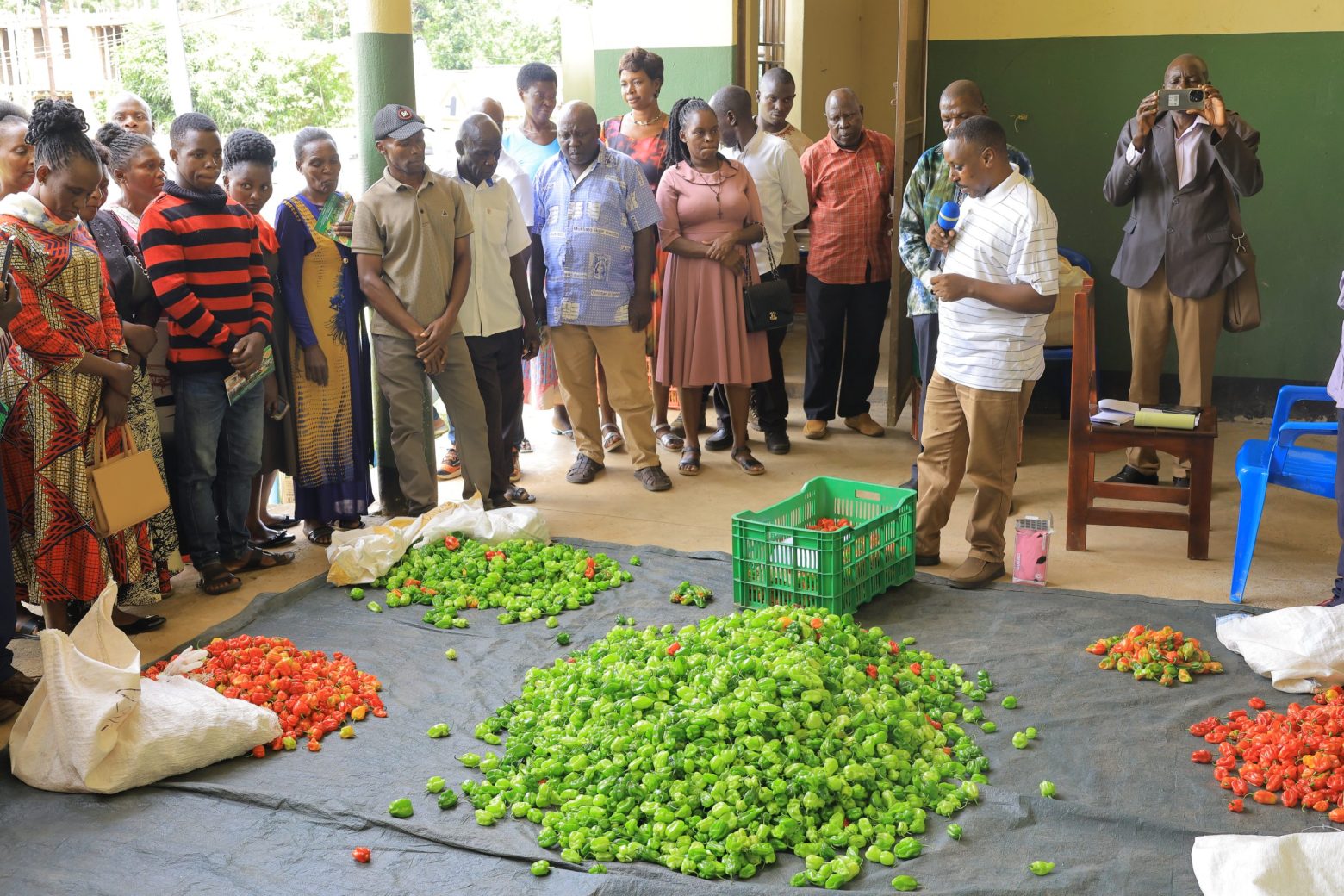
Horticultural farmers in the Bunyoro Region have entered a joint venture with local exporter KK Foods to supply produce to Western Europe, including the United Kingdom, in a move aimed at boosting incomes and expanding access to international markets.
The farmers, operating under the Albertine Farmers Association (AFA), signed a Memorandum of Understanding (MoU) with KK Foods following a training programme that equipped them with skills in commercial production and export readiness.
Speaking at the launch of the venture at the Ageteraine Agro-Processing Facility in Hoima City over the weekend, AFA Chairperson Julius Kwamya said the partnership marks a significant milestone for the farmers.
“During the training, we agreed on the way forward. We will start with hot pepper and chilli, but plan to scale up to other enterprises. These crops offer high turnover within a short growing period, making them ideal for our farmers,” Kwamya said.
Demand for chilli and hot pepper is rising in European markets, driven by increasing immigration and a growing appetite for diverse, spicy cuisines. Major importers include France, Spain, the United Kingdom, and Germany.
The joint venture is one of the key outcomes of a capacity-building workshop held in August 2025, where over 30 horticultural farmers were trained by Stanbic Business Incubator Limited (SBIL) under the Albertine Agribusiness Development Programme (ADP), in partnership with the Uganda National Oil Company (UNOC).
Kwamya noted that AFA currently has 1,930 registered members and is targeting 10,000 by the end of 2026. However, he cited limited access to extension services as a major challenge affecting productivity and called on the government to strengthen support at the grassroots level.
SBIL Chief Executive Officer Catherine Poran said the initiative reflects the importance of linking farmers to markets.
“It is encouraging to see farmers putting theory into practice. Growing food is one thing, but connecting farmers to markets and enabling them to earn from their efforts is what truly drives transformation. At Stanbic Business Incubator, our mandate is to support enterprises to scale and realise their full potential,” she said.
Nicholas Atukwase, Production Manager at KK Foods, revealed that the company requires at least 50 tonnes of produce per week to meet demand.
“There is a strong market for chilli and hot pepper. Farmers must ensure quality, consistency, and compliance with customer and regulatory requirements to fully benefit from this opportunity,” he said.
Percy Mucunguzi, National Content Officer in charge of Measurements and Reporting at UNOC, commended the farmers for working collectively and sharing knowledge.
“We encourage the cascading of knowledge. Building the capacity of Ugandans requires collective effort, and initiatives like this ensure that benefits reach more people,” he said.
Mucunguzi also urged farmers to diversify their activities to tap into broader opportunities linked to the oil and gas sector, including food supply, medical services, insurance, and transport.
Emmanuel Blair Niyitegeka, Senior Agricultural Inspector at the Ministry of Agriculture’s Department of Crop Inspection and Certification, emphasized the need to meet strict export standards.
“Hot pepper has high demand in Europe, the Middle East, and parts of Asia. However, farmers must ensure their produce is free from pests and complies with pesticide regulations. Proper farm monitoring and correct application of inputs are critical,” he said.
He added that the European Union and the United Kingdom have particularly stringent standards, requiring strict adherence to quality and safety protocols.
Dr Charles Kajura, Hoima District Production Officer, stressed the importance of farmer traceability in export markets.
“Each farmer must be registered and assigned a code. This allows us to trace produce back to its source in case of any quality concerns,” he explained.
To address gaps in extension services, Kajura said the district is promoting group-based approaches and introducing Community-Based Facilitators (CBFs).
“We are encouraging farmers to organise into groups so extension workers can reach them more efficiently. Additionally, we are training two CBFs per parish to provide ongoing support at the community level,” he said.
The initiative is expected to strengthen Uganda’s horticultural export sector while improving livelihoods for farmers in the Albertine region.
Ends.