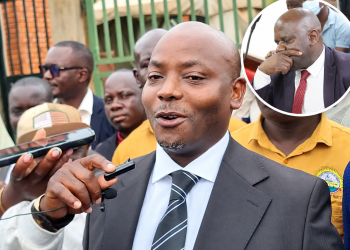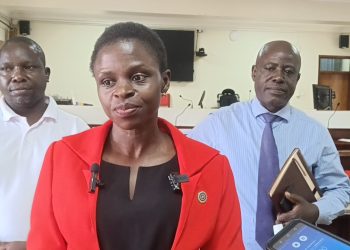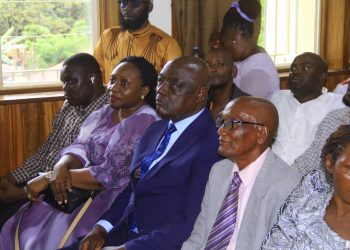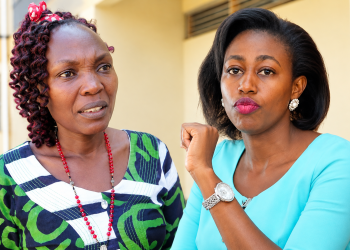












Lawyers for Johnson Muyanja Ssenyonga, the petitioner in the Mukono LC5 election dispute, have subjected the Electoral Commission Returning Officer and several presiding officers to intense cross examination over missing results, contradictory figures and irregular entries on declaration of results forms.
The witnesses were questioned as the High Court in Mukono continued hearing Muyanja’s petition challenging the election of Francis Lukooya Mukoome as Mukono District chairperson.
The petition centres on the events surrounding the January 22, 2026 election, during which Returning Officer Emily Amongin initially announced Muyanja as the winner before later declaring Lukooya the winner following a review of the results.
The initial declaration gave Muyanja 51,686 votes against Lukooya’s 50,254. A revised tally later announced by Amongin gave Lukooya 52,523 votes and Muyanja 52,105, resulting in a reversal that is at the centre of the petition.
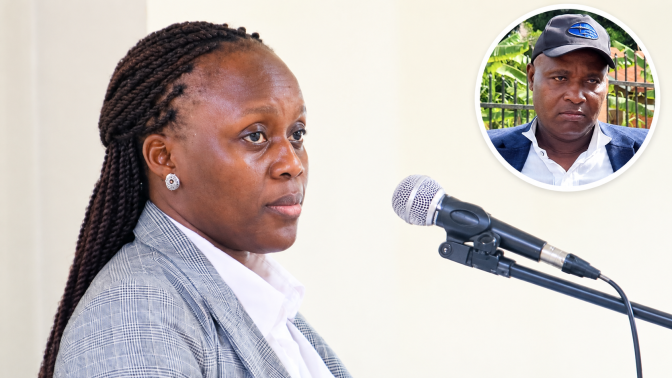
Amongin, 36, a resident of Entebbe, told court that she had served as a returning officer for about six years and was responsible for returning the Mukono District election results.
Muyanja’s lawyers put it to her that she had initially declared their client the winner before subsequently declaring Lukooya.
Amongin denied this in her affidavit, maintaining that she declared the candidate who obtained the highest number of votes.
She told court that the Electoral Commission tallied the votes cast and acknowledged that discrepancies in figures could arise during the tallying process.
Asked when she could reject a declaration of results form, Amongin said she would do so where figures on the form did not tally with the other declaration forms.
Her testimony was, however, tested against specific forms presented before court.
At Kiwafu Tea Estate polling station, the declaration of results form contained a comment by the presiding officer alleging that ballot papers had been taken by armed personnel.
Despite the comment, Amongin proceeded to tally the results from the station.
She confirmed that she was not physically present at the polling station but maintained that the polling materials were available.
The petitioner’s lawyers also pointed out that some polling agents had not signed the declaration of results form.
Amongin maintained that she could not rely solely on the form where an issue had been reported to her, adding that complaints arising from polling stations were handled through the appropriate reporting channels.
Another declaration of results form from Namumpa polling station came under scrutiny after Muyanja’s lawyers drew Amongin’s attention to a handwritten comment alleging that some ballot papers had been ticked by armed personnel.
Amongin had earlier confirmed in her affidavit that she interacted with the polling officers.
She also confirmed that she tallied 100 votes for Lukooya from the station but admitted that she had not read the comment on the reverse side of the form before tallying the figures.
Asked whether she agreed with the statement concerning the ballot papers, Amongin declined to adopt the comment.
Justice Phillip Mwaka intervened, observing that Amongin could not be expected to agree with a statement she had not personally written.
Amongin further told court that where the number of votes cast contradicted the number of votes counted, she did not automatically cancel the results.
The testimony brought into focus the distinction between mathematical inconsistencies on individual declaration forms and the broader question of whether such discrepancies affected the validity of the results eventually declared.
1,942 registered voters from four stations not reflected in tally
One of the significant issues raised during cross examination concerned four polling stations whose results were not included in the final tally.
Amongin confirmed that Mukono District had 960 polling stations and that voting took place across the district.
However, the certified tally records presented in court showed no results for Madujju Mosque, Mpunge Primary School in Busooke-Kikeera, Mpunge NAK-Z and Buwujja Faith Nursery School.
The four stations had 278, 665, 618 and 381 registered voters respectively, giving a combined total of 1,942 registered voters.
Amongin confirmed that voting had taken place at the stations but said the results were not received.
She further confirmed that violence had been reported in some of the affected areas.
At Buwujja Faith Nursery School, for instance, she said she did not receive the results.
Despite the missing returns, Amongin confirmed that Lukooya was declared the winner by a margin of 418 votes.
During re-examination by Electoral Commission lawyer Hamidu Logoloobi, Amongin explained that where results were not received, the sub-county supervisor reported the matter and the affected stations were not included in the final tally.
She maintained that after tallying the available returns, Lukooya had obtained the highest number of votes and was therefore declared the winner.
The petitioner’s lawyers, however, questioned why Amongin’s affidavit did not specifically mention violence at the affected polling stations or attach an official police report relating to the alleged incidents.
Amongin also confirmed that her affidavit did not contain a police reference number relating to the alleged violence.
Dispute over certified declaration forms
The petitioner’s lawyers also questioned Amongin about copies of declaration of results forms attached to the petition.
Amongin had referred in her affidavit to forms presented by Muyanja as false declaration forms.
However, when asked whether she had personally examined all the copies attached to the petitioner’s affidavit, she said she could not remember.
Muyanja’s lawyers later presented a compilation of certified declaration of results forms and asked Amongin to confirm whether she had examined them.
Justice Mwaka stopped the exercise and directed the lawyers to bear in mind that certification of Electoral Commission documents was the responsibility of the Commission Secretary.
The judge then directed counsel to move to another issue.
Amongin was also questioned about alterations on declaration of results forms.
She told court that alterations to declared results would not necessarily carry signatures.
Asked whether objections raised at polling stations were recorded on the declaration forms, she said the objections themselves were not recorded, although complaints could be made through the appropriate channels.
Security presence at tally centre
The circumstances surrounding the January 23 declaration also came under scrutiny.
Amongin told court that security officers were present at the tally centre while the results were being processed.
Muyanja’s lawyers asked whether she knew several Mukono political leaders, including Hajji Haruna Ssemakula, Esther Nakyanzi, Captain Reagan Muganza and Godfrey Mwogeza.
Amongin said she was not aware of them.
She also told court that none of the named leaders entered the tally centre before Lukooya was declared the winner.
Polling officials concede arithmetic errors
The cross examination earlier started with individual polling stations, where several presiding officers were questioned about figures recorded on declaration of results forms.
Yulian Nalwanga, a presiding officer at Nasuuti UCC J-T, was asked to explain figures recorded on her declaration form.
The form indicated that Lukooya had received 95 votes, while Muyanja had zero votes and Reuben Ssenyonjo had also received 95 votes.
The same form recorded 95 male and female voters as having turned up to vote and showed 95 valid votes cast.
Asked how Lukooya could have obtained 95 votes when the total valid votes cast was also 95 and another candidate was recorded with 95 votes, Nalwanga could not immediately explain the discrepancy.
She acknowledged that there could have been an error in tallying, although she said the mistake related to the total figures.
Nalwanga also confirmed that she did not personally enter all the figures despite having tallied the votes and signed the form.
She acknowledged that, according to her training, presiding officers were expected to fill the forms themselves.
During re-examination, she maintained that the error arose from adding the numbers of male and female voters against the total number of valid votes cast.
Another presiding officer admits tallying error
Godfrey Nsamba, 43, a resident of Kitto-Kiganda, was the presiding officer at Kisoga Central polling station.
He confirmed that he supervised the tallying of votes and signed the declaration form, although he initially declined to acknowledge that he had filled it himself.
When the form was shown to him, he accepted it as the document he had signed.
The form indicated that 209 female and 160 male voters had turned up to vote, giving a total of 369 voters.
However, the results recorded on the same form showed Lukooya with 355 votes, Muyanja with 30, Reuben Ssenyonjo with two and two invalid votes, producing a total of 389 votes.
Nsamba conceded that there must have been an error in the tallying.
He told court that such errors could be corrected if the court allowed it, explaining that a figure could sometimes be mistakenly entered or added.
During re-examination, he attributed some possible discrepancies to situations in which voters confirmed their details in the register but were subsequently rejected by the biometric verification machine.
‘I started with the right figures’
Another presiding officer, Luke Byamukama, 28, a third year Makerere University student residing in Kyetume, was questioned over figures recorded at Basiima Kikooza Catholic Church polling station.
Byamukama told court that the number of voters depended on the ballots issued.
The declaration form recorded 226 female voters and 171 male voters, giving a total of 397 voters. It also showed 253 unused ballots.
The form contained crossings and new figures written over crossed out entries.
Byamukama initially rejected the suggestion that figures on the form had been crossed out and replaced.
The petitioner’s lawyers also presented different copies of the declaration form.
One copy showed 14 votes for Lukooya, while a certified copy showed 300 votes written over the earlier figure.
Byamukama denied personally imposing the figures.
However, he explained that he had initially started with the actual votes but later, amid pressure, ended up with different figures.
During re-examination, he said voting at the station had proceeded smoothly and maintained that he had initially written the correct figures consciously.
Affidavit expunged after witness fails to appear
The court also expunged the affidavit of Peter Ssekiwanda after he failed to appear for cross examination.
Ssekiwanda had been listed as a witness, but the respondents told court that he was not present.
Muyanja’s lawyers asked the court to remove his affidavit from the record on the ground that they had been denied an opportunity to cross examine him.
Justice Mwaka granted the request and expunged the affidavit.
Lukooya side declines cross examination
At the close of the witness examination, Humphrey Ategeka, lawyer for Lukooya, told court that the respondents did not intend to cross examine the petitioner’s witnesses.
The petitioner’s lawyers likewise indicated that they were not interested in cross examining witnesses presented by Lukooya.
Justice Mwaka subsequently adjourned the matter before setting dates for final submissions and rejoinder.
The case now moves towards the final stage, with the central dispute being whether the revised declaration in favour of Lukooya accurately reflected the results from the polling stations and whether the alleged discrepancies and missing returns materially affected the outcome.
The court has yet to determine the merits of those allegations.
ENDS.