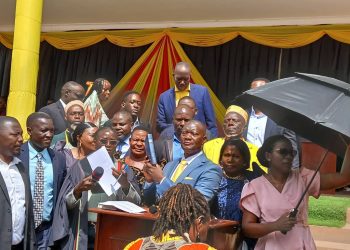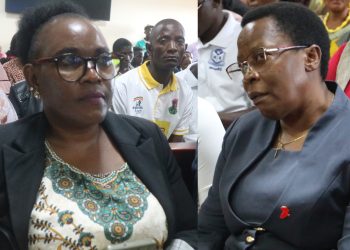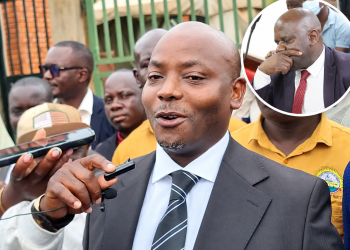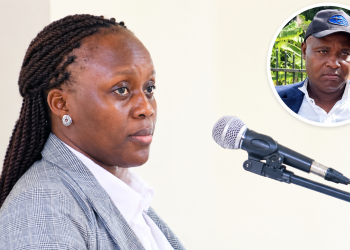

















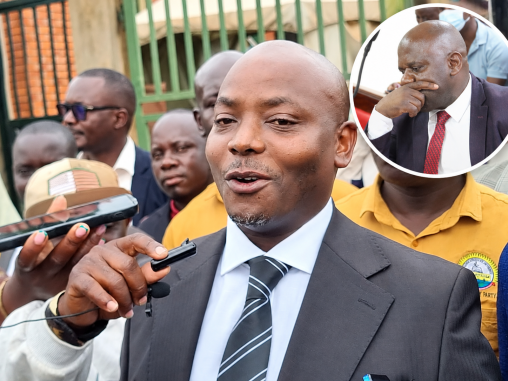
The High Court in Mukono has adjourned the hearing of the election petition challenging the election of Mukono County North MP Abdallah Kiwanuka after lawyers clashed over who should bear the costs of a hearing that could not proceed.
Justice Godfrey Himbaza considered awarding costs to compensate lawyers who had travelled to court and spent time preparing for proceedings that were ultimately postponed.
The judge said the costs could cover expenses such as lawyers’ time and transport.
The proposal followed a request by Ronald Kibuule’s lawyer, Frank Kandiho, for the adjournment to be granted with costs against Kiwanuka’s side.
Kandiho argued that the defence had appeared in court with several lawyers but only informed the court that it was not ready to proceed because some documents had not yet been marked for identification.
Kiwanuka’s lawyer, Chrisostom Katumba, opposed the request for costs and asked the court to adjourn the matter without penalising the defence.
Katumba also urged the court to first rule on a pending dispute over how Kibuule intends to present evidence before the parties proceed with the substantive hearing.
Justice Himbaza ultimately adjourned the proceedings without awarding costs.
The judge, however, fixed October 19 to 23, 2026 for the substantive hearing and directed both sides to be fully prepared.
“There will be no further adjournments,” the judge warned.
The court will on Friday, October 2, at 2pm deliver its ruling on whether Kibuule can call 65 of his 70 witnesses to give oral evidence.
65 witnesses trigger procedural fight
The costs dispute came against the backdrop of a major procedural disagreement over Kibuule’s proposed witnesses.
Kandiho asked the court to allow 65 of the petitioner’s 70 witnesses to testify orally.
The application was opposed by Katumba, who argued that the petitioner should rely on witness statements filed and served in accordance with the applicable civil procedure rules.
Katumba argued that the statements should be adopted as evidence in chief after the witnesses take the oath, after which the opposing side would cross-examine them where necessary.
He told court that allowing 65 witnesses to give oral evidence would change the manner in which the petition is supposed to be prosecuted.
He further argued that calling witnesses one by one would leave the defence having to determine, after each witness, which of its own witnesses should be called to rebut the evidence.
The defence therefore argued that the petitioner should not be allowed to use oral testimony to cure what it considers a failure to properly present the evidence.
Lawyers disagree on affidavit evidence
The dispute also extended to whether affidavit evidence is the prescribed method of proving allegations in election petitions.
Katumba relied on the Supreme Court decision in Besigye v Museveni, arguing that election petition evidence has traditionally been presented through affidavits.
Kandiho rejected the interpretation, describing the argument as “all form and no beer”.
He argued that the Supreme Court decision had been cited out of context because it dealt specifically with rules governing presidential election petitions.
Kandiho also told court that lawyers representing the Electoral Commission had not objected to the petitioner’s intention to seek leave to call witnesses orally.
He argued that Kibuule, as the petitioner, bears responsibility for prosecuting his case and should not be required to identify beforehand which witnesses Kiwanuka would need to call in response to particular evidence.
Kandiho further relied on Kayanja Vincent De Paul v Fabrice Rulinda, arguing that affidavit evidence is not the only means through which allegations in an election petition can be proved.
Lawyer Ivan Bwowe supported Kibuule’s application, arguing that oral evidence is permissible in election petition proceedings where the court grants leave.
Justice Himbaza reserved his decision on the objection and scheduled the ruling for Friday.
The petition was filed by former State Minister for Water Ronald Kibuule, who is challenging Kiwanuka’s election in the January 15, 2026 parliamentary elections.
The substantive hearing is now scheduled to run for five days, from October 19 to 23.