
























Parliament’s Infrastructure Committee has opened a review of Uganda’s digital number plate rollout after Members of Parliament and stakeholders raised questions over production capacity, reported plate shortages, tax revenue and the involvement of a single company in the Intelligent Transport Monitoring System
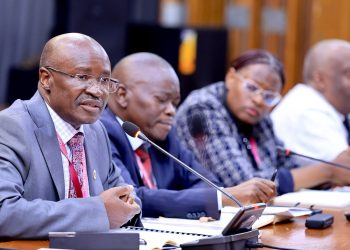
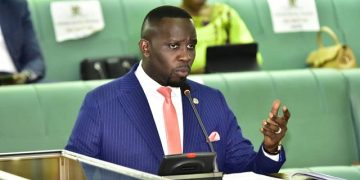
The Infrastructure Committee chairperson Mwine Mpaka said MPs had found conflicting information between government records and figures provided by the company implementing the project.
Mpaka said a Ministry of Works and Transport report indicated that government had lost about Shs106 billion in tax revenue, with weekly losses estimated at about Shs four billion.
The committee was also told that the number of plates being issued had fallen from about 350 to 100, despite ITMS reporting that its plant can produce 2,500 plates a day.
“There is a lot of contradicting information. This is something we have just started today and we hope to conclude,” Mpaka said.
He said MPs would establish whether the project has sufficient capacity to meet demand and whether government adequately prepared for the transition.
The committee will also examine claims about money generated by the project leaving the country.
Mpaka said installing 1,500 plates a day at a reported cost of about Shs714,000 per unit would amount to more than Shs1 billion daily, although he said the figures had not yet been verified.
“We are looking for a solution without entirely affecting the main principle, which is security,” he said.
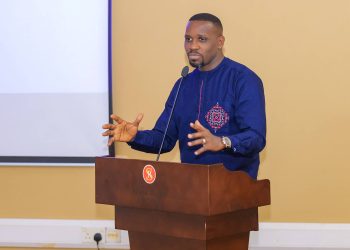
Responding to the concerns, Steven Turyarugayo, IIntelligent Transport Monitoring System (ITMS) Public Relations Manager, said the company currently has capacity to produce 2,500 number plates per day, or nearly 50,000 a month.
He challenged the claim that production capacity had fallen to 100 plates a day, saying the source, reporting period and methodology behind the figure should first be established.
Turyarugayo said vehicle registration involves several stages and institutions, meaning a registration delay should not automatically be classified as a digital number plate delay.
He said 84 per cent of registrations are currently completed within 24 hours after payment, with the project working towards having fully cleared vehicles fitted with plates on the same day.
ITMS has also expanded its fitment network, with centres in Gulu, Fort Portal, Malaba, Mutukula, Jinja, Masaka, Mbarara and Arua. Kampala has several mobile units and 26 stationary installation centres.
On the security benefits of the system, Turyarugayo cited police operational figures showing that 203 stolen motor vehicles and 95 motorcycles were recovered between January and July 2026.
He said 43 of 49 vehicles reported stolen in July were recovered, representing an 88 per cent recovery rate.
Turyarugayo said allegations of corruption should also be traced through financial transactions, including who requested or received money and what service it was paid for. He said ITMS has established an anti-corruption hotline for reporting suspected irregularities.
Bwire Kezekia, chairperson of the Clearing and Forwarding Association, questioned ITMS’s reported capacity to install up to 1,600 plates a day, saying the figures should be reconciled with import records.
He urged the Uganda Revenue Authority to establish whether raw materials used to manufacture the plates were properly imported and declared.
Bwire said some motorists had waited for up to three months for plates after paying the required taxes and fees.
“If I pay taxes, I pay even for a number plate and wait for the number plate to be [issued],” he said.
Allan Ssenyondwa, Director of Policy Research and Advocacy at the Uganda Manufacturers Association, said the project had become an economic issue as well as a security intervention.
Ssenyondwa said manufacturers had warned against allowing a single company to dominate the project because of possible capacity and supply challenges.
He said Uganda’s manufacturing sector contributes about 16.5 per cent of GDP and approximately 30 per cent of tax revenue, and should therefore be considered in major economic decisions.
“We use three principles: price, quantity, weight. That is all we use,” Ssenyondwa said.
He said more manufacturers could participate if security requirements were maintained, particularly as Uganda may eventually need to transition up to 1.8 million vehicles to the digital system.
Frank Mawejje, chairperson of the Union Transport Alliance, called for Parliament to investigate the ownership and operations of ITMS.
“I doubt whether the gentlemen before us are the rightful owners of ITMS,” Mawejje said.
He also raised concerns over local companies that were previously involved in producing number plates, citing Tumpeco as an example.
Mawejje urged Parliament to consult transport operators, including motorcycle riders and other users.
Mpaka said the committee would conduct field visits and engage more stakeholders before reaching conclusions.
“In a period of two weeks maximum, we shall have all the answers, including going to the field and interacting with all the necessary stakeholders,” he said.
The committee will examine production and installation capacity, importation of plates and raw materials, tax implications, registration delays, local manufacturing and the contractual arrangement governing the project.