























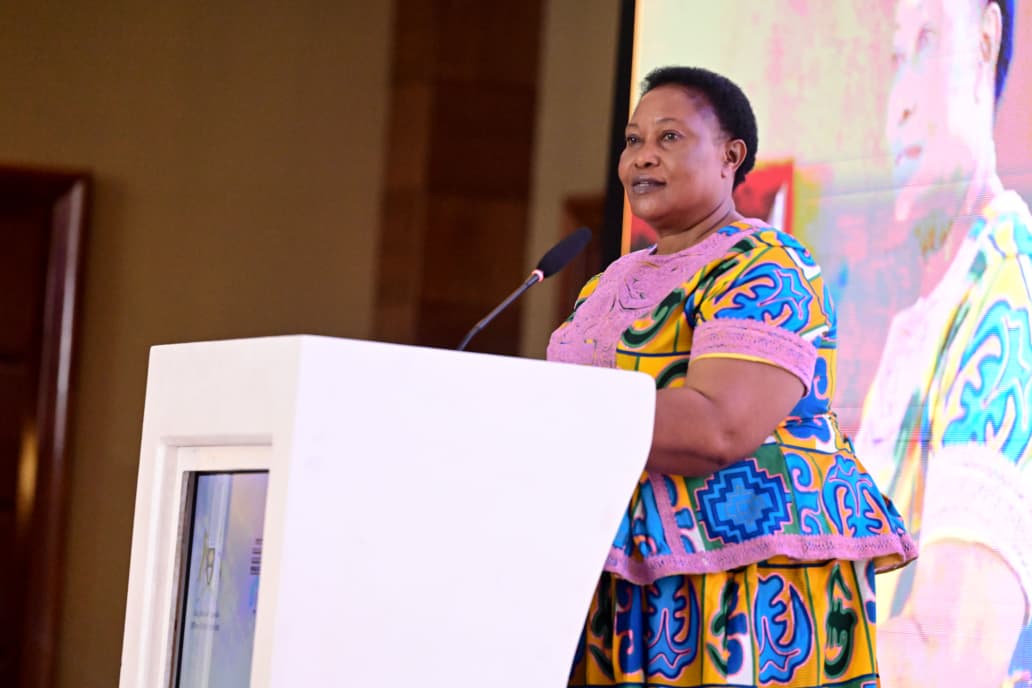
KAMPALA — Minister for the Presidency Milly Babalanda has called for a major overhaul of Uganda’s development financing system to enable the country to achieve its ambitious target of expanding the economy from about US$50 billion to US$500 billion by 2040.
Babalanda made the call during a high-level policy dialogue on Uganda’s development financing architecture held at Sheraton Hotel in Kampala.
She said the country’s Tenfold Growth Strategy requires more than increased government spending, arguing that Uganda must develop a financing system capable of mobilising and deploying capital on a much larger scale.
“Under His Excellency’s leadership, Uganda has set an ambitious development trajectory through the Tenfold Growth Strategy to expand the economy from approximately US$50 billion to US$500 billion by 2040, driven by sustained double-digit growth and transformation of the productive sectors,” Babalanda said.
She commended President Yoweri Kaguta Museveni for providing what she described as strategic leadership and direction towards Uganda’s socio-economic transformation.
According to Babalanda, achieving the tenfold growth target will require a substantial expansion of Uganda’s productive capacity, investment, value addition, exports and employment.
“The question before us is fundamental: How do we finance an economy that we intend to grow tenfold? This is not simply a question of finding more money. It is about whether our financing architecture can support the scale and nature of transformation Uganda has set out to achieve,” she said.
The Minister identified agro-industrialisation, tourism, mineral development including oil and gas, and science, technology and innovation including ICT as the four anchor sectors expected to drive the strategy.
She said the sectors would be critical in increasing production and productivity, expanding value addition and exports, attracting investment, creating jobs and raising household incomes.
Babalanda said the country’s financing architecture must therefore be aligned with these priorities and ensure that national development ambitions are matched with adequate and affordable capital.
Citing the Fourth National Development Plan, she said implementation of the five-year plan is estimated to require about Shs593.6 trillion, with 69.6 percent expected to come from the public sector and 30.4 percent from the private sector.
She said the figures demonstrate that Uganda cannot rely on the national budget alone to finance its long-term transformation.
“Government will continue strengthening domestic revenue mobilisation and directing resources towards national priorities. However, Uganda cannot finance its transformation through the national budget alone,” Babalanda said.
She called for broader mobilisation of domestic capital, stronger development finance institutions, deeper capital markets, expanded public-private partnerships and increased private investment.
She also urged stakeholders to explore alternative sources of long-term financing, including pension and insurance funds, climate and green finance, blended finance and Islamic finance.
Babalanda said Uganda should also work towards increasing national savings to 40 percent of gross domestic product by 2040, as envisaged under the Tenfold Growth Strategy.
She challenged policymakers and financial sector players to find ways of converting growing domestic savings into productive, long-term investments capable of supporting the country’s economic ambitions.
The Minister also asked how Uganda can deepen its capital markets to enable businesses and major national projects to access long-term financing, strengthen development finance institutions to support productive sectors and create appropriate instruments through which pension funds, insurance companies and other institutional investors can safely participate in national development.
“A country seeking sustained economic transformation must progressively build the capacity to mobilise and invest its own capital,” she said.
Babalanda stressed that the private sector must be treated as a central partner in Uganda’s economic transformation rather than simply as a beneficiary of government policies.
She said government resources should be used strategically to attract and leverage private capital, with some projects financed directly by government, others by the private sector and others through joint arrangements such as public-private partnerships, blended finance and risk-sharing mechanisms.
The Minister also called for a shift in Uganda’s engagement with development partners and international financial institutions.
While acknowledging the continued importance of development assistance and concessional financing, she said international partnerships should increasingly focus on investment, trade, technology transfer, productive capacity, affordable long-term financing and mobilisation of private capital.
She said concessional resources should also be deployed strategically to reduce investment risks and attract larger amounts of private and institutional capital.
Babalanda cautioned, however, that financing should not become an end in itself, saying the ultimate measure of success should be whether mobilised resources translate into increased production, productivity, value addition, exports, employment, enterprise growth and higher household incomes.
She tasked the dialogue with developing a clear financing framework for the Tenfold Growth Strategy, identifying the policy, regulatory and institutional reforms required to mobilise capital at scale and outlining immediate actions that government and development partners should undertake to accelerate implementation.
The dialogue brought together Members of Parliament, the Head of Public Service and Secretary to Cabinet, the Executive Director of the National Planning Authority, heads of government institutions, development partners, representatives of international financial institutions, private sector leaders and officials from financial institutions, among other stakeholders.