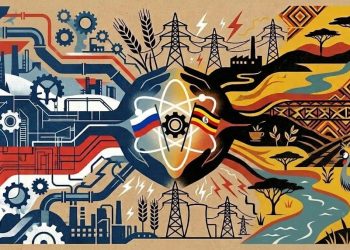
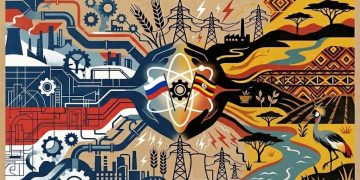













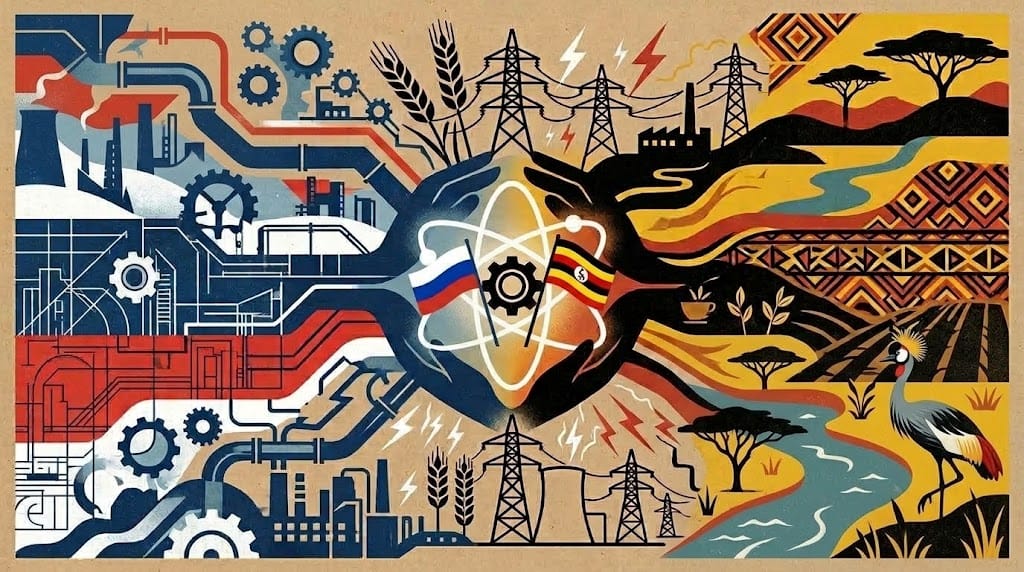
Uganda and Russia have reaffirmed their commitment to strengthening bilateral cooperation, with energy, security, trade, technology and industrial development emerging as key areas of focus.
The Chargé d’Affaires ad interim of Russia in Uganda, Sergey Lobanov, said Moscow remains committed to supporting Uganda’s development through long term partnerships in strategic sectors.
Lobanov made the remarks on October 7, 2026, while opening a Russia Uganda cooperation roundtable in Kampala, held ahead of the third Russia Africa Summit scheduled for October 28 and 29 in Moscow.
He noted that diplomatic relations between the former Soviet Union and Uganda were established on October 13, 1962, shortly after Uganda gained independence, and said the two countries would soon commemorate 64 years of diplomatic relations.
“We were one of the first powers to recognize the sovereignty and independence of Uganda,” Lobanov said.
He highlighted ongoing cooperation between Russia’s state nuclear corporation, Rosatom, and Uganda’s Ministry of Energy and Mineral Development, expressing optimism that projects involving the peaceful use of nuclear energy would soon move forward.
“At the end of this month, the third Russia Africa Summit will be held in Russia. We hope that its results will make it possible to raise bilateral relations to new heights in the sphere of energy, trade, the economy, science and technology,” he said.
The summit is expected to focus on areas including energy, digital technologies, artificial intelligence and alternative payment systems.
During the Kampala roundtable, participants discussed energy security, nuclear power, oil and gas, electrification, trade and human resource development.
The discussions emphasized the need for Uganda and Russia to move beyond conventional commodity trade towards long term industrial partnerships, technology transfer, local production and development of Ugandan technical expertise.
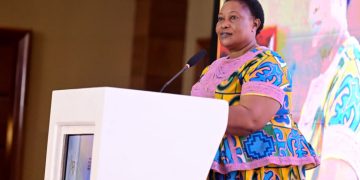
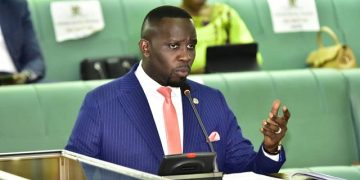
Uganda’s senior energy specialist, Damalia Noel Abbo Ofumbe, outlined the country’s ambitious plans for expanding electricity generation, including through nuclear power.
She said Uganda’s 2023 Energy Policy projects that the country could require up to 52,000 megawatts of electricity generation capacity by 2040, with about 24,000 megawatts expected to come from nuclear power.
“Since 2007 we have faced a number of problems, such as drought on the Nile River, so we had to revise our energy balance. We are developing hydro and solar energy, but we also need other sources. That is how the need arose for nuclear energy,” Ofumbe said.
She said several potential locations for a nuclear power plant had been identified, including Buende, Nakasongola, Lamu and Kihura.
According to Ofumbe, Uganda is currently engaged in negotiations with Rosatom, while a site assessment in Nakasongola is planned. The proposed project would involve a 7,200 megawatt nuclear power station comprising six reactors, each with a capacity of about 1,200 megawatts, using Russian technology.
“We recently signed a roadmap for this project,” she said.
Ofumbe said Uganda and Russia signed a memorandum of understanding on nuclear cooperation in 2017, followed by an intergovernmental agreement in Vienna in 2019.
She said the feasibility study is expected to be completed by 2030, while the first reactor could be commissioned between 2035 and 2038.
However, Ofumbe stressed that Uganda’s interest in nuclear technology goes beyond electricity generation.
“We are already implementing projects for the diagnosis and treatment of cancer at the Uganda Cancer Institute, and we are working on food safety and the diagnosis of animal diseases, such as foot and mouth disease,” she said.
She identified skills transfer as one of the most important components of the proposed nuclear programme, arguing that Ugandans must eventually have the capacity to operate and maintain the facilities independently.
“The station will operate for 100 years, and Ugandans must be able to independently manage and maintain it,” she said.
Russian academic Denis Degteev said the upcoming Russia Africa Summit would seek to move relations between Russia and African countries from conventional trade towards deeper and more sustainable production partnerships.
He said Russia Africa trade currently stands at about $27 billion, but argued that greater emphasis should be placed on joint production, technology transfer and industrial development.
Degteev cited the development of the El Dabaa nuclear power plant in Egypt as an important milestone in Africa’s nuclear energy sector.
“Atomic energy gives an enormous impetus to electricity generation, which is vital for the industrialization of Africa,” he said.
He also highlighted the potential for cooperation in the East African region, particularly in the oil and gas sector.
Degteev noted that although East African countries have significant petroleum resources, the region continues to import large quantities of refined petroleum products.
“We hope that the oil extracted in Uganda will be processed locally and exported to neighboring countries. Russia is ready to participate in the development of regional energy projects,” he said.
SEATINI Uganda Deputy Executive Director Herbert Kafiro described energy as a critical component of Uganda’s economic security and industrialisation strategy.
He said Uganda’s ambition to build a $500 billion economy by 2040 would require a major expansion of industrial production, which in turn depends on reliable and affordable energy.
“Uganda dreams of a $500 billion economy, and this is impossible without industrialization, which, in turn, is impossible without energy,” Kafiro said.
He argued that nuclear energy should be integrated into Uganda’s wider development strategy rather than being viewed solely as a source of electricity.
According to Kafiro, nuclear technology could support sectors such as agriculture and healthcare while also contributing to industrialisation.
He also raised concerns about Uganda’s trade imbalance with Russia, noting that Uganda imports machinery and wheat while its exports to Russia remain largely dominated by raw commodities such as coffee and tea.
“We need to negotiate the export of value-added goods. By exporting raw materials, we export jobs,” he said.
Kafiro called for broader negotiations involving government agencies, farmers, the Ministry of Trade and the Ministry of Agriculture to identify products that Uganda can process locally and export to Russia and other international markets.
Other participants in the roundtable included Rosatom representative Elsie Pule and Russian academic Denis Degteev.
The discussions underscored a shared interest in expanding Uganda Russia relations beyond traditional diplomatic and commercial ties towards energy cooperation, industrialisation, technology transfer, skills development and regional economic integration.