



























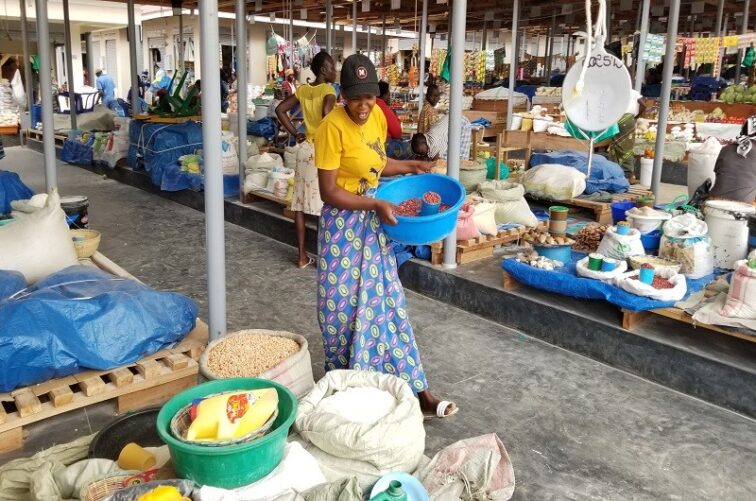
On a busy morning in Kampala’s Kalerwe Market, a woman buying beans asks for half a kilogram. The vendor does not reach for a digital scale. Instead, she plunges a faded plastic cup into a sack of beans, taps it lightly against the rim to settle the contents, levels it with the side of her hand and empties it into a black polythene bag. The customer watches closely, nods in approval, pays and walks away.
The transaction takes less than a minute, yet it reveals an enduring contradiction at the heart of Uganda’s economy. More than half a century after the country adopted the metric system and despite laws requiring certified weighing equipment for commercial trade, millions of Ugandans continue to buy and sell food using measures that exist nowhere in the statute books.
The tumpeco, as Ugandans refer to the simple plastic measuring cup, remains the accepted measure for beans, maize flour, rice, sugar and powdered detergent. The tumpeco is not limited to dry goods. In many parts of Uganda, the same plastic cup is used to measure liquids such as milk, cooking oil and paraffin. One tumpeco is commonly understood to represent half a litre, while two cups make a litre.
SEE: https://x.com/Stillme0/status/1791519855117545693
The practice extends well beyond grains and dry goods. Along highways and in rural trading centres, petrol and diesel sold in recycled plastic bottles are rarely measured using certified equipment. Instead, traders rely on familiar containers, including mineral water bottles, soft drink bottles and jerrycans, whose volumes are widely understood by both buyers and sellers.
Elsewhere, butchers still balance meat against sealed packets of salt, while cooking oil is sold in loosely defined quantities known as akawujjo, measures understood instinctively by regular customers but impossible to verify.
To regulators, these practices expose consumers to exploitation and undermine fair trade. To many traders and shoppers, they represent something entirely different. They are practical, inexpensive and, perhaps most importantly, rooted in relationships built over years of daily exchange.
“I think the first tumpeco was indeed half a kilo,” says Alex Kamoga, a 70-year-old retired civil servant who has shopped in Kampala’s traditional markets for decades. “These days, the cups have reduced in size. I’m not sure what they are measuring anymore.”
His observation captures a concern increasingly voiced by older consumers who believe the plastic cup, once widely accepted as equivalent to half a kilogram, has quietly shrunk over time. Few buyers carry weighing scales to verify the quantities they receive. Instead, they rely on memory, familiarity and comparison. Traders reject suggestions that customers are being short-changed, arguing that measurements remain consistent within each market and that buyers understand exactly what they are purchasing.
That informal consensus has proved remarkably resilient despite repeated interventions by the Uganda National Bureau of Standards (UNBS), the agency mandated to enforce the Weights and Measures Act. Officials routinely inspect markets, verify commercial weighing equipment and confiscate scales found to be inaccurate or unapproved. Their argument is straightforward. Every trader should sell precisely the quantity a customer pays for, regardless of whether the purchase is a kilogram of beans or two hundred grams of sugar.
Yet the reality inside Uganda’s markets is considerably more complex than the regulations suggest. Many consumers place greater trust in the plastic cup than in the digital scale.
“The scales cheat,” says Benah Namuli as she shops for beans in Kalerwe. Her view reflects a widespread suspicion that weighing machines are easily manipulated or poorly maintained. In recent years UNBS inspectors have repeatedly uncovered unverified commercial scales during market inspections, reinforcing public scepticism about mechanical measurements. For many shoppers, watching a trader fill and level a cup in full view appears more transparent than relying on numbers displayed on a digital screen whose accuracy they cannot judge.
Juma Mutyabya, resident of Kawempe opines that the persistence of these informal measures is also driven by economics.
“Uganda’s retail trade remains overwhelmingly informal, dominated by small family businesses operating with limited capital. Certified commercial scales are significantly more expensive than a plastic cup, require periodic verification and, in some cases, repairs or replacement,” he said.
The challenge is evident even where markets have undergone formal redevelopment. Herbert Odama, chairperson of the Arua Main Market Vendors Association, told radio pacis back in March this year compliance with measurement standards remains limited despite years of sensitisation.
Out of the market’s 1,563 registered vendors, he said, only about one in five uses weighing scales that have been verified and stamped by UNBS.
“Majority of the vendors are not using these scales because they feel they don’t make a lot of sales and profits. Others subject them for verification and they don’t use the stamped ones, they have others that they use instead. The challenge is UNBS doesn’t frequent the market. They come either once or twice a year,” Odama said .
His remarks point to the practical limits facing regulators. Enforcing measurement standards across thousands of markets and roadside trading centres requires manpower, funding and sustained inspections that are difficult to maintain. Even where enforcement succeeds temporarily, old practices often return once inspectors leave.
However, experts argue that informal measurement systems should not be dismissed as outdated practices or simple resistance to regulation. Instead, they reflect adaptive methods that have evolved to meet the practical realities of everyday trade.
A 2024 study, Measuring Beyond the Standard: Informal Measurement Systems as Cognitive Technologies by Kaaronen and colleagues, argues that body-based and container-based measures, such as handspans, heaps, baskets and cups, are not primitive substitutes for standard units. Rather, they are practical cognitive tools that continue to serve important economic and social functions.
“They are adaptive, “double-life” cognitive tools providing practical advantages in everyday commerce and social life,” the study reads.
Across much of Africa, long before the introduction of legal metrology, markets operated through shared conventions built over generations of repeated exchange. Measures such as cups, heaps, baskets and bundles became accepted units of trade because communities collectively understood and trusted them. Their authority rested less on scientific precision than on social consensus and familiarity.
Uganda’s tampeeko belongs to that tradition. It survives because it performs functions extending beyond measurement. It speeds transactions, lowers business costs and reinforces relationships between traders and customers who often know one another by name. A loyal customer may receive a slightly heaped cup or an extra handful of beans without asking. Such gestures would be impossible in the rigid arithmetic of certified scales, yet they remain central to the social fabric of market exchange.
The country’s retail economy now sits at the intersection of two competing systems. On one side stand regulators seeking accuracy, consumer protection and integration into a modern economy governed by uniform standards. On the other stand millions of traders and consumers whose daily commercial practices continue to depend on customs that have evolved over generations rather than through legislation.