

















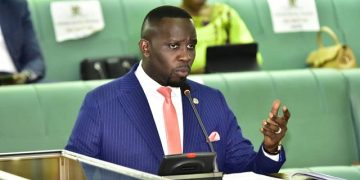









Former Internal Affairs Minister Kahinda Otafiire has questioned the effectiveness of Uganda’s digital number plate system, telling Parliament that it added little value to existing vehicle tracking capabilities during his tenure.
Otafiire, now Minister of Water and Environment, raised concerns about the technology’s ability to detect removed number plates, its compatibility with existing police systems and the justification for the reported US$25 million software cost.
He made the remarks while appearing before Parliament’s Physical Infrastructure Committee, chaired by Mwine Mpaka, which is investigating the implementation, cost and performance of the Intelligent Transport Monitoring System (ITMS).
Otafiire said he had questioned the technology before implementation because Uganda’s existing traffic cameras used Chinese technology, while the proposed system relied on equipment associated with Russia.
“I said what is coming from Russia does not necessarily match with what we have on the ground, because the technology we have is Chinese,” he told MPs, adding that compatibility should have been established before the systems were integrated.
He said he consulted the police, Makerere University and colleagues in Kenya, who, according to him, expressed reservations about the technology.
To demonstrate his concerns, Otafiire recounted an experiment in which number plates were removed from a vehicle and taken to his office on Jinja Road while the vehicle remained elsewhere.
He said the system failed to alert him that the plates had been separated from the vehicle, raising questions about its ability to detect tampering and prevent criminals from using stolen or transferred number plates.
“The numbers can be removed, and the numbers will be removed,” Otafiire said, adding that he could not confidently point to significant improvements in vehicle security during his time as Internal Affairs minister.
However, former Works and Transport Minister Edward Katumba Wamala defended the effectiveness of the police’s existing surveillance system, saying it had helped authorities track down suspects involved in the assassination attempt against him on June 1, 2021.
Katumba, now Minister of Public Service, told the committee that he was a direct beneficiary of the system because it enabled investigators to trace the gunmen who attempted to kill him.
“I am a beneficiary of the system which the police is operating,” Katumba said, adding that the technology helped him identify the suspects when he appeared in court.
He, however, expressed uncertainty about whether the additional security features introduced under the digital number plate project had improved the existing system.
His testimony highlighted the potential of surveillance technology in crime detection but also raised questions about whether the digital number plate project had delivered additional capabilities beyond those already available to the police.
Otafiire maintained that police already had a functioning system for issuing instant traffic penalties before the introduction of ITMS. He said attempts to integrate the contractor’s system with the police platform created operational challenges, nearly triggering a strike by traffic officers.
MPs also questioned the reported US$25 million software cost, demanding evidence that the investment was justified by the system’s performance.
The committee raised concerns about the financial model, including charges of Shs50,000 and Shs150,000 for some existing number plates compared with Shs714,300 discussed for new digital plates. Legislators also questioned why motorcycles should attract the same charge as motor vehicles.
Winstone Katushabe, Commissioner for Transport Regulation and Safety at the Ministry of Works and Transport, said the government needed a modern vehicle registration system to improve tracking, strengthen enforcement and maintain reliable records from registration to disposal.
He added that Uganda was losing an estimated Shs100 billion to Shs150 billion annually through irregularities involving vehicles entering the country through porous borders.
The committee has demanded a review of the project’s financial model, verification of the contractor’s investment and clear performance indicators.
While Katumba’s testimony points to the value of police surveillance in solving serious crimes, Otafiire’s concerns have intensified scrutiny of whether the digital number plates themselves deliver sufficient security benefits to justify their cost.
The inquiry is expected to establish whether the system is meeting its intended objectives and what improvements may be necessary to ensure taxpayers receive value for money.